
With the winter sports season upon us, skiers and snowboarders alike are dusting off the Gore-tex jackets, getting equipment checks done and assessing gear for another fun-filled season. In order to ensure a healthy season, on top of the usual snow dance to ensure Mother Nature cooperates, skiers and snowboarders should give consideration to understanding a bit more about the most common ski and snowboarding injuries and how to prevent them.
Granted, skiing and snowboarding are among the safest recreational activities with average injury rates of 2.6 per 1,000 skier visits and 6.97 per 1,000 snowboarder visits. Given that skiers and boarders hit the slopes a record 57.6 million times in the 2002-2003 season, those injury rates correspond to a 0.26% rate of injury for skiers and a slightly higher 0.70% rate of injury for snowboarders. (Statistics derived from studies conducted by the National Ski Areas Association representing 90% of all ski areas operated in the United States.) Regardless, such statistics are of little comfort if you happen to be one of the very unlucky few to get injured during the season. Understanding the most common injuries and the mechanisms that cause them may help boost the odds in your favor of not being sidelined this season by an injury.
By far, the most common injury among alpine skiers involves the lower extremities, specifically, the knees. Based on statistics from the National Ski Areas Association, knee injuries comprise approximately 30% of all types of skiing injuries, with the ligaments the most likely point of damage. Understanding the structure of the knee helps in understanding how these types of injuries can occur.
The human knee represents the intersection of two of the three long bones in the leg, the femur in the thigh and the tibia in the lower leg. The bottom end of the femur and the top end of the tibia are covered in cartilage, which acts as a cushion for each. The cartilage on the femur is called the articular cartilage and the cartilage on the tibia is the lateral meniscus. Holding the two ends of long bone together are two sets of ligaments. On the outside of the knee is the lateral collateral ligament and on the inside is the medial collateral ligament. Additionally, two other ligaments connect the bottom end of the femur and the top end of the tibia. Shaped like a cross, the ligament towards the back of the knee is the posterior cruciate ligament and the ligament towards the front of the knee is the anterior cruciate ligament. In skiing, the medial collateral ligament or MCL and the anterior cruciate ligament or ACL, are the soft tissues most often injured by stretching or tearing, either partially or completely.
MCL injuries generally tend to occur in beginner and lower intermediate skiers due to the mechanism of injury. Specifically, stress placed on the MCL in beginner and lower intermediate skiing techniques cause pulls or tears in this ligament. For example, in beginners, this may occur while the skier is in the snowplow or wedge position. If a skier’s stance becomes too wide, pressure exerted by the downward force of the thigh muscles, particularly in a fall, may stretch the MCL past its limits causing the pull or tear. In lower intermediate skiers, MCL injuries typically occur when the skier “catches an edge” or crosses a tip causing undue force on one leg or the other from the sudden loss of balance. Avoiding MCL injuries is best accomplished through a combination of conditioning prior to skiing in order to strengthen leg muscles and ensuring that bindings are set to the correct DIN with corresponding release checks. While skiing, skiers should avoid fighting falls to extreme degrees allowing the fall to occur rather than risk excessive torque to one leg or the other (snow is fairly soft!). Beginners should try to avoid a very wide wedge position. And, of course, taking lessons to improve balance and control are always good ideas!
ACL injuries tend to occur in one of three ways: 1) “phantom foot,” 2) boot induced and 3) acceleration incidents caused by another skier or boarder. In the “phantom foot” scenario, injury to the ACL is caused by a combination of the stiff rear portion of the ski and the ski boot. When a skier falls backwards, sits back on his ski or attempts to get up from a sitting position while still moving, the upper body pushes against the rear of the ski and the boot (i.e., the “phantom foot”). This causes extreme forces at the knee pushing the lower leg forward and beyond the limits of its flexibility thus inducing a sprain or tear in the ACL. The second means by which an ACL sprain or tear can be induced is by the boot itself. This typically occurs when a skier sits too far back during a jump with the legs extended. Upon landing the force of the stiff rear of the boot pushes the lower leg forward out from under the femur, causing a sprain or tear. The other means for ACL injury is caused by collisions when another skier or snowboarder hits the lower part of a skier standing still. The sudden transfer of force from the moving skier to the stationary skier may cause the lower leg of the stationary skier to move out from under the femur and sprain or tear the ACL.
In order to minimize the chance of an ACL injury, skiers should take similar steps to avoid an MCL injury - getting in shape before hitting the slopes and ensuring bindings have been serviced and checked. From there, skiers tip the odds in their favor while skiing by taking some of the following steps: 1) try to maintain a balanced skiing position over the tops of the skis at all times (i.e., don’t lean back!) (a series of lessons from a PSIA certified instructor are a good way to learn how to do this or break bad habits), 2) in a fall, avoid excessive fighting of the fall and direct the fall to the sides to the extent possible, 3) do not attempt to get up from a fall while still moving, 4) keep knees slightly flexed during jumps, remaining over the center of the skis and absorb landings, 5) avoid stopping or standing in high traffic areas (i.e., stand to the side!) and look uphill occasionally and definitely before resuming skiing. Following these steps will not guarantee a healthy ACL, but it will certainly reduce the chances of injury this ski season.
Unlike skiers, the most common injuries among snowboarders involve the upper extremities. Specifically, injuries to the wrist and shoulder comprise approximately 30% of all snowboarder injuries (20% wrist, 10% shoulder). Why this occurs can be seen in the different style of sliding. When strapped into their equipment, snowboarders have both feet locked into one set position. As a result, during a fall, snowboarders cannot attempt to recover by moving one leg independently of the other. The natural instinct, instead, is to use the outstretched arm to stop a fall. The force of the falling body, combined with any momentum generated during boarding, will transfer to the arm stressing structures within the arm, typically at the wrist or shoulder.
As with knees, it is helpful to understand the structure of the wrist and shoulder. The human wrist is the intersection of the long bones of the arm (the radius and ulna) with the bony structures of the hand (the carpals). The shoulder is the intersection of the other long bone in the arm (the humerus) and the shoulder bone or scapula. The joint cavity between the humerus and scapula is cushioned by cartilage covering the head of the humerus and concave area of the scapula where the head of the humerus sits. The scapula extends up and around the shoulder joint at the rear and around the shoulder joint at the front.
During a fall onto an outstretched arm, the force of the fall may cause breaks in any of the bones in the wrist, including the radius, ulna or carpals. Breaks can involve a single fracture (simple) or many fractures in many of the bones in the wrist (compound). They include open fractures (where broken ends of bone may have pierced the skin from the inside) or closed. A break of the radius and/or ulna will cause the arm to take on the appearance of an upside down fork. Breaks in the carpals may cause little obvious deformity, but cause swelling in the wrist area. In the shoulder area, the force of the fall on an outstretched arm may cause damage to the humerus or scapula, including factures or even disclocation of the shoulder out of its socket.
While the list of preventative measures that snowboarders can take to minimize the potential for wrist and shoulder injuries is not long, there are some important steps boarders can take. For beginners who are more prone to fall, taking lessons from a certified instructor will help in catching on to snowboarding more quickly and minimizing the number of falls. For all snowboarders, other steps include learning techniques of falling that prevent reliance upon the outstretched arm. While seemingly counterintuitive, snowboarders can learn to “roll” into a fall so as to dissipate the energy of the fall over a wider area of the body. Other steps include investing in and using wrist guards. Due to the rise in popularity of snowboarding, equipment manufacturers have been improving on the design and function of wrist guards specifically intended for use by snowboarders. There are even combination wrist guards and snow gloves on the market. Use of these devices may help decrease the potential for a broken wrist.
It is important to recognize that the steps recommended above will only help to reduce the potential for injury. They are not absolute guarantees. However, knowledge about the most common types of injuries and how they occur can help tip the odds in your favor for having a fun, safe and injury-free season. Think snow!
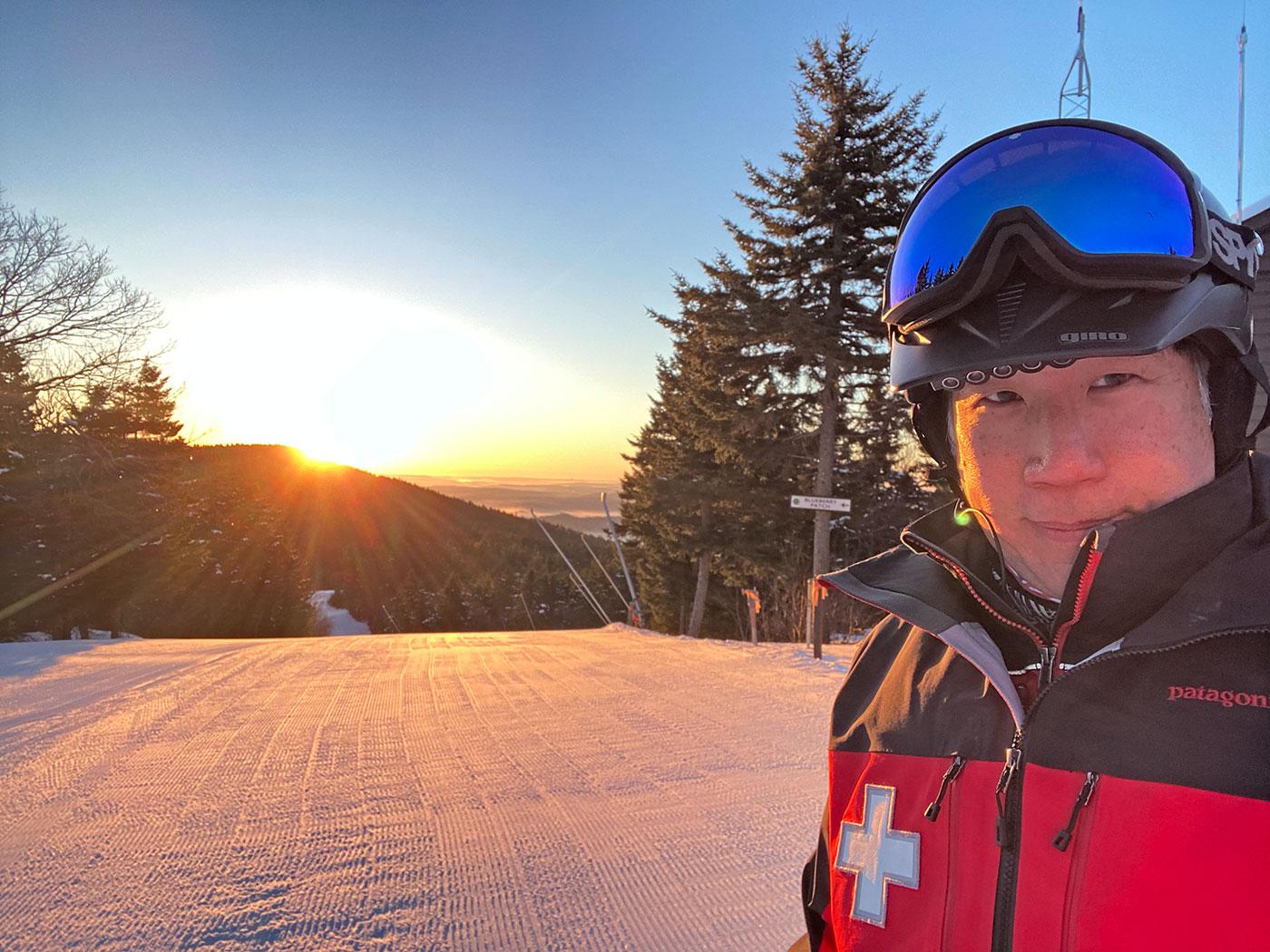
James "Jim" Chen is a member of the National Ski Patrol and former Patrol Director at Liberty Mountain Resort. After nearly 30 years at Liberty Mountain, Jim and his family relocated to New England in 2024 where he continues patrolling at Ragged Mountain Resort. In the off season, Jim enjoys hiking New England mountains and fishing in local lakes, rivers and streams.

Join the conversation by logging in.
Don't have an account? Create one here.