Scott: You built your own rope tow and private ski area more than 20 years ago. How did the idea first come about? Had you seen others doing something similar at the time?
Kevin: 50 years ago, my dad took me to Jericho Ski Hill in Marlboro, Massachusetts for my first day of skiing. They had 2 rope tows and the mechanics of a rope tow instantly fascinated this 8-year old’s mind. Within a year, I remember trying to motorize the clothes line with an old motor from a washing machine. I couldn’t understand how the motor grabs the rope.
I later learned about double pulleys. Fast forward to 25 years ago when I built my first rope tow. It was 120 feet long, used 5/8th inch hardware store rope, and was powered by a 1/3rd horsepower engine. And it worked! 3 years later when I decided to buy my first home, I searched for land that I could build a big rope tow on.
Scott: For context, what are the basic stats of the setup today — roughly how long is the rope tow, and how much vertical does it serve?
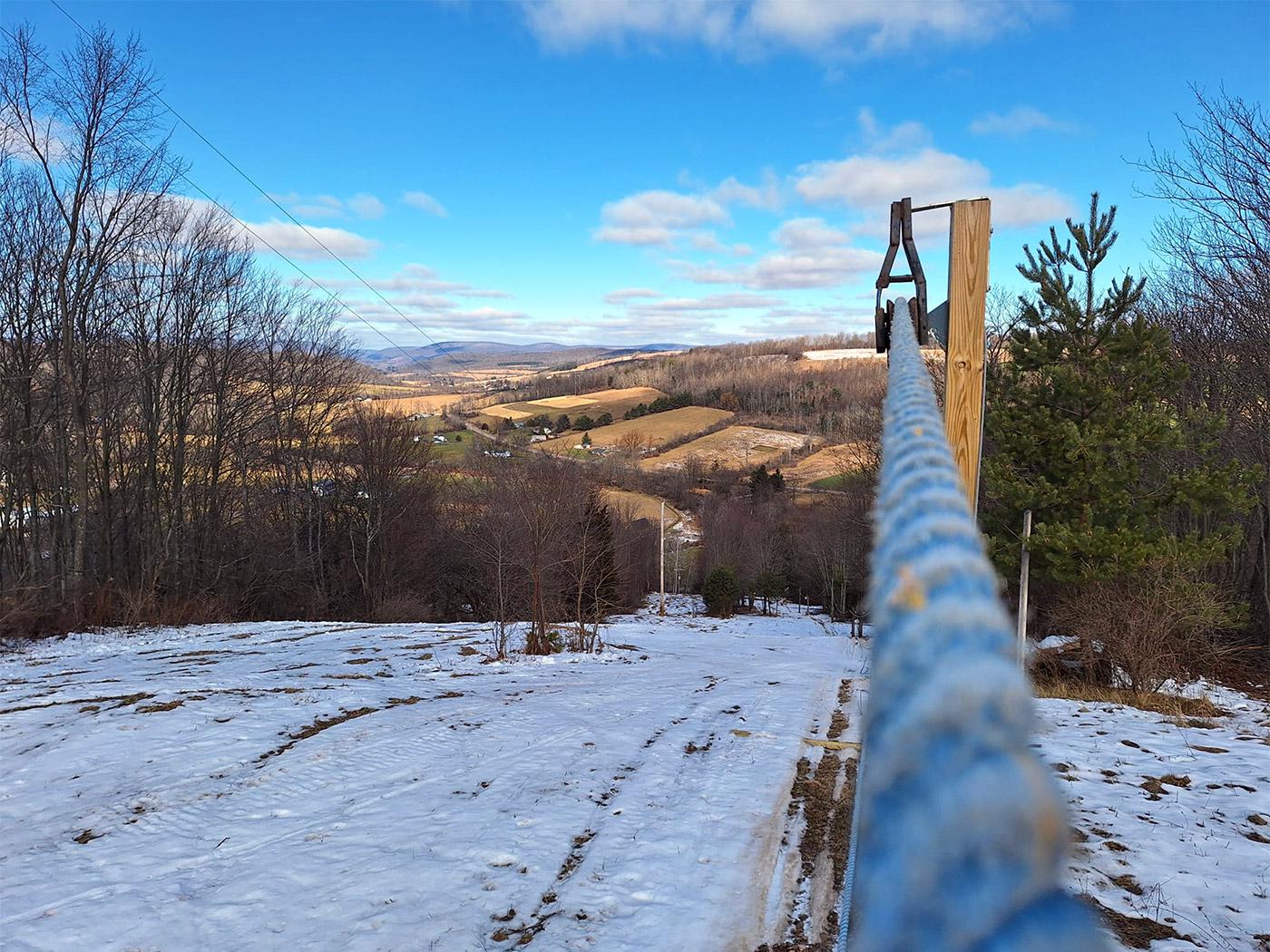
Kevin: My rope tow is very steep. You ride for 775 feet and rise 235 feet. That’s a 31% average grade with the lower section around 40%.
I use 1 1/8 inch rope that I paid about $2 a foot for ($3,200 in total). Parts of my rope are original. I have 3 pieces of rope with 3 splices. This is because I extended my tow twice, each time requiring more rope.
The tow runs at 850 feet per minute or about 10 mph. It takes 55 seconds to ride. You can comfortably take 20 runs in an hour. That’s 4,700 vertical feet per hour. There are not many ski lifts out there that are as vertical efficient.
Scott: What kind of trail or land maintenance is required during the off-season to keep the area skiable?
Kevin: I was very lucky to find land with very few rocks, saving me a lot of work. I mow and brush hog about once a month in the summer.
There’s always a project going on like adding more trails with night skiing or a new trail. I probably put 10 to 15 hours a week into my ski area on average. It’s my gym, you can’t work on a hill without a workout! I use a regular push mower on most of my main slope to keep it lawn-like. That’s about an acre of grass.
Scott: Being located in Pennsylvania, winters can be hit or miss. Since you rely entirely on natural snow, how many skiable days does a typical winter usually provide?
Kevin: I keep a journal and have run the tow a total of 334 days across 22 winter seasons. I ski about 16 days a season, which is probably half of the days there was enough snow. I retired a year ago so I plan to ski more than in the past. My house averages 70 inches of seasonal snowfall. Not much.
Scott: Do you do anything to manage or “groom” the snow surface, even in a very simple or improvised way?
Kevin: I built two drag-behind groomers for each of my snowmobiles. I have a few grooming videos on my Facebook page: Kevin’s Rope Tow. It works surprisingly well.
I learned a lot about snow conservation and grooming technicalities. My best tip: Always pack your snow where you are going to ski and let it settle for an hour or longer. It will fuse back together and hold up much better.
Scott: Have you ever considered experimenting with snowmaking? What ultimately makes that practical — or impractical — at a backyard scale?
Kevin: If I had a dollar for every time that I was asked this!
I once tried to build a snowmaking pond with little success. My main slope would require an acre of coverage to open. Making a foot of snow on an acre (an acre foot) requires 200,000 gallons of water. I did experiment a little and quickly learned my well can only put out 500 gallons of water per day. Plus I would need a way to move the snow and the energy cost to make an acre foot I estimated at $500 to $1000 each time.
Scott: Wow. So that’s not feasible at all! Speaking of your land, what was it about this particular piece of land that made it suitable for skiing in the first place?
Kevin: My hill has the perfect set up. A nice blue and black level pitch with no rocks. It has two fall lines, northwest and northeast, allowing a lot of terrain from the top of the tow (14 plus trails). It is 500 feet higher than nearby Mansfield, PA, giving me a little extra snow.
Scott: How would you describe the terrain to someone familiar with Mid-Atlantic resorts? Are there specific trails or areas you think offer a comparable feel?
Kevin: I designed my ski area like no other. My only lift is a high-speed rope tow, I rarely groom, there are narrow trails with surprises and I always liked glades. With no snowmaking, I can leave trees on the trails if I choose.
I will ski on very thin cover using rock skis. I need only 2 to 3 inches to open my main slope. My powder days last for days! It takes a long time to track out 14 runs.
Scott: Walk us through the rope tow itself. Did you design and build it from scratch, adapt existing equipment, or start with a commercially available system?
Kevin: Most rope tows in the past were individually designed. Some used old cars, some used only mining equipment or a hodgepodge of parts.
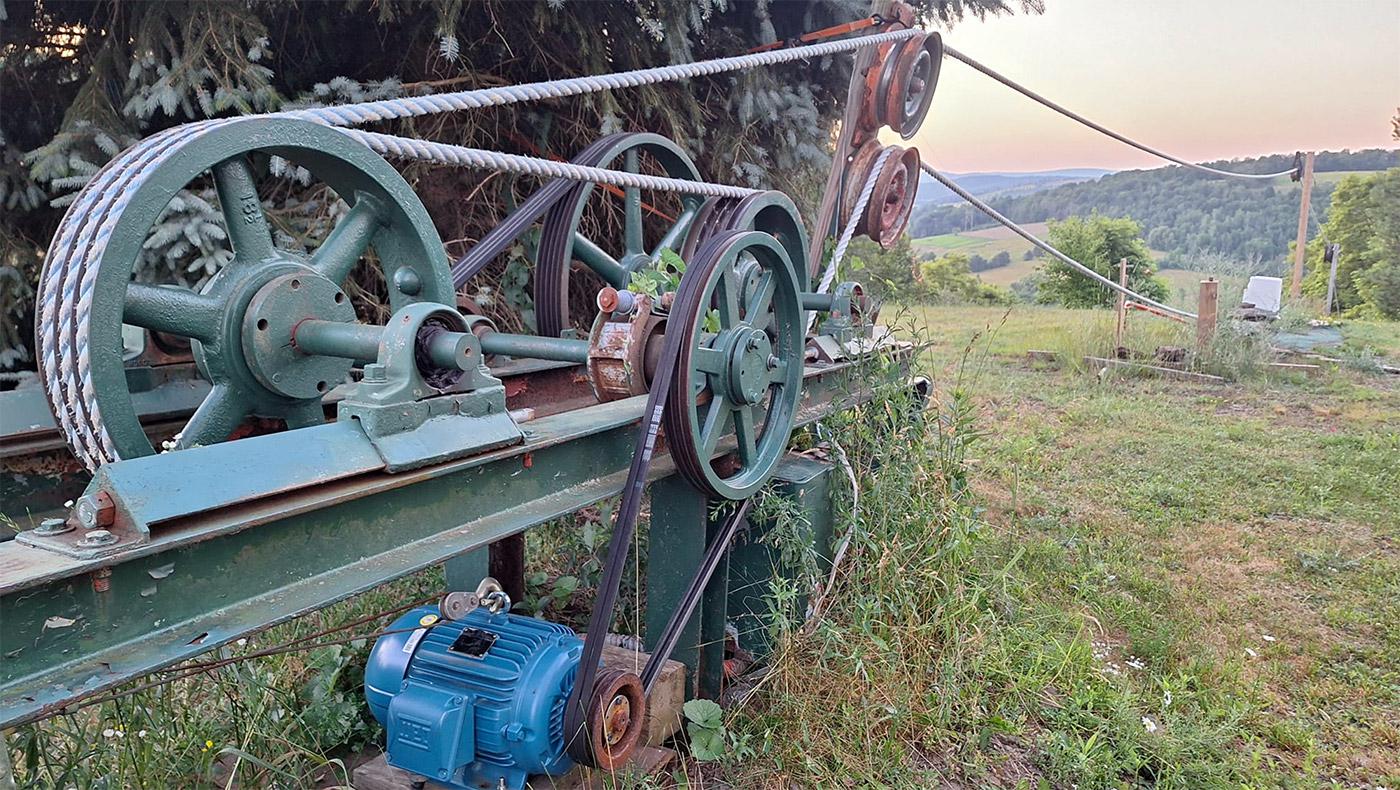
My tow came from Ski Denton. They originally bought it from a lost ski area near Pittsburg but never used it. TowPro from New Hampshire helped me to modify it to electric. TowPro builds ready-to-go rope tows. It’s hard to find an old rope tow drive for sale. It used to be fairly easy.
Scott: Has the tow evolved over time? If so, what kinds of changes or improvements have you made over the years?
Kevin: When I built the tow it was 625’, it’s now 775’ long. The extension added some very steep terrain on the bottom that I originally thought was unskiable with an average annual snowfall of just 70 inches or so.
The extra 150 feet increased the vertical from 165 to 235. My average grade on the rope tow is now 31%, with the lower section at 45% grade. I brought in an excavator to make a couple of less-steep trails, allowing skiing even when the snow base is only a couple of inches deep.
Scott: What were the biggest technical challenges in getting the rope tow to operate reliably?
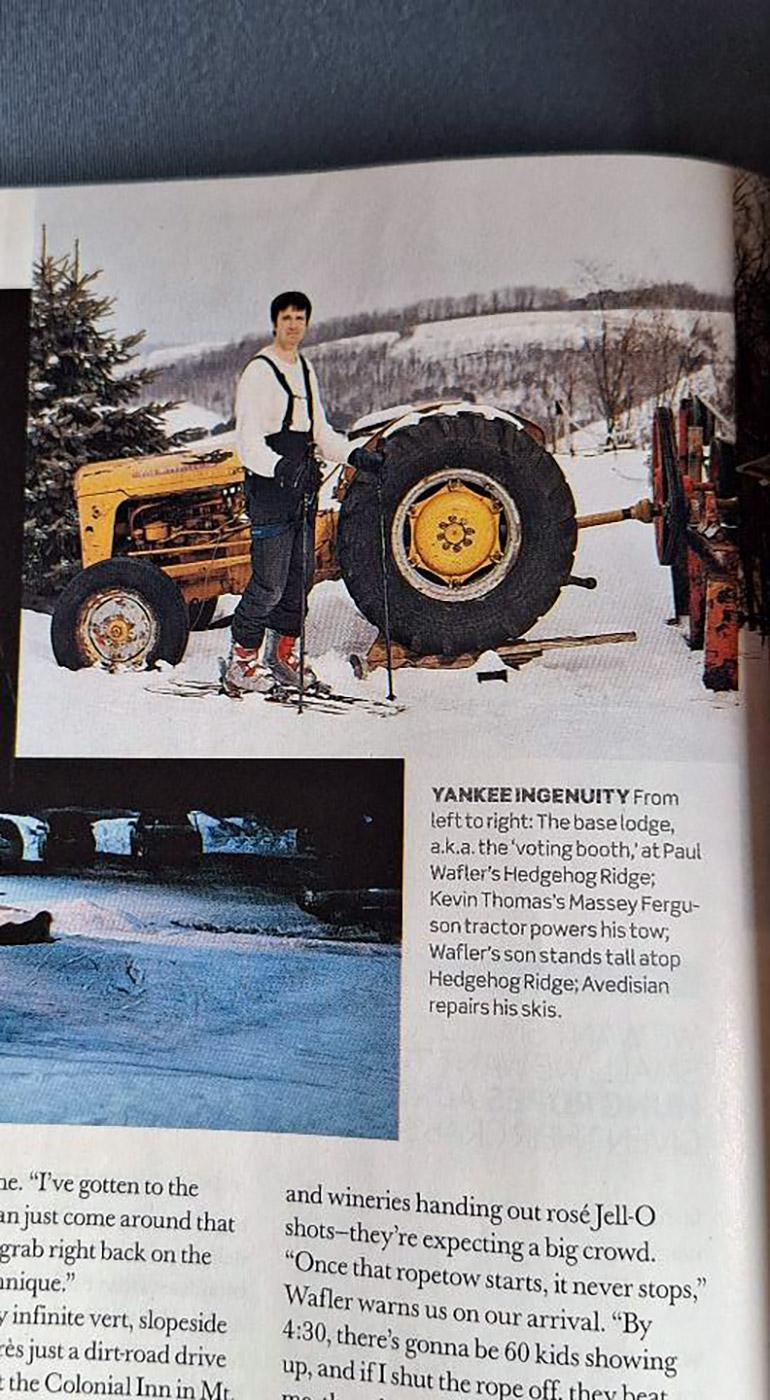
Kevin: The tow for the first 17 years was powered by my 1956 Massey Ferguson 35-hp gas tractor’s Power Take-Off (PTO). It used a gallon of gas per hour and ran the whole time that I was skiing.
5 years ago, with the help of TowPro, I modified my rope to run on electric power. I ran a control wire to the bottom, which enabled me to turn the tow on and off at the bottom. The tow now automatically turns off when the last rider gets to the top, and with the touch of a button, turns back on at the bottom, accelerating from 0 to 9 mph in 5 seconds for a smooth start.
Now the tow only runs about 12 minutes per hour of skiing, saving wear and tear on the rope and equipment. It’s overbuilt with a 10-hp motor; I could have used 5-hp and still had 4 riders at a time on the tow at full speed.
Since it only runs for 55 seconds on each run, I use very little electricity. I estimate it’s about 4 runs per penny of electricty. It draws about 1,600 watts for each skier it’s pulling at 9 mph. Rope tows are very energy efficient.
Scott: What kind of regular maintenance does the tow require during the season?
Kevin: The tow itself takes very little maintenance. I leave my rope up all summer and usually run it a couple times in the summer just to make sure everything is running OK, or if we go grass skiing, which we occasionally do.
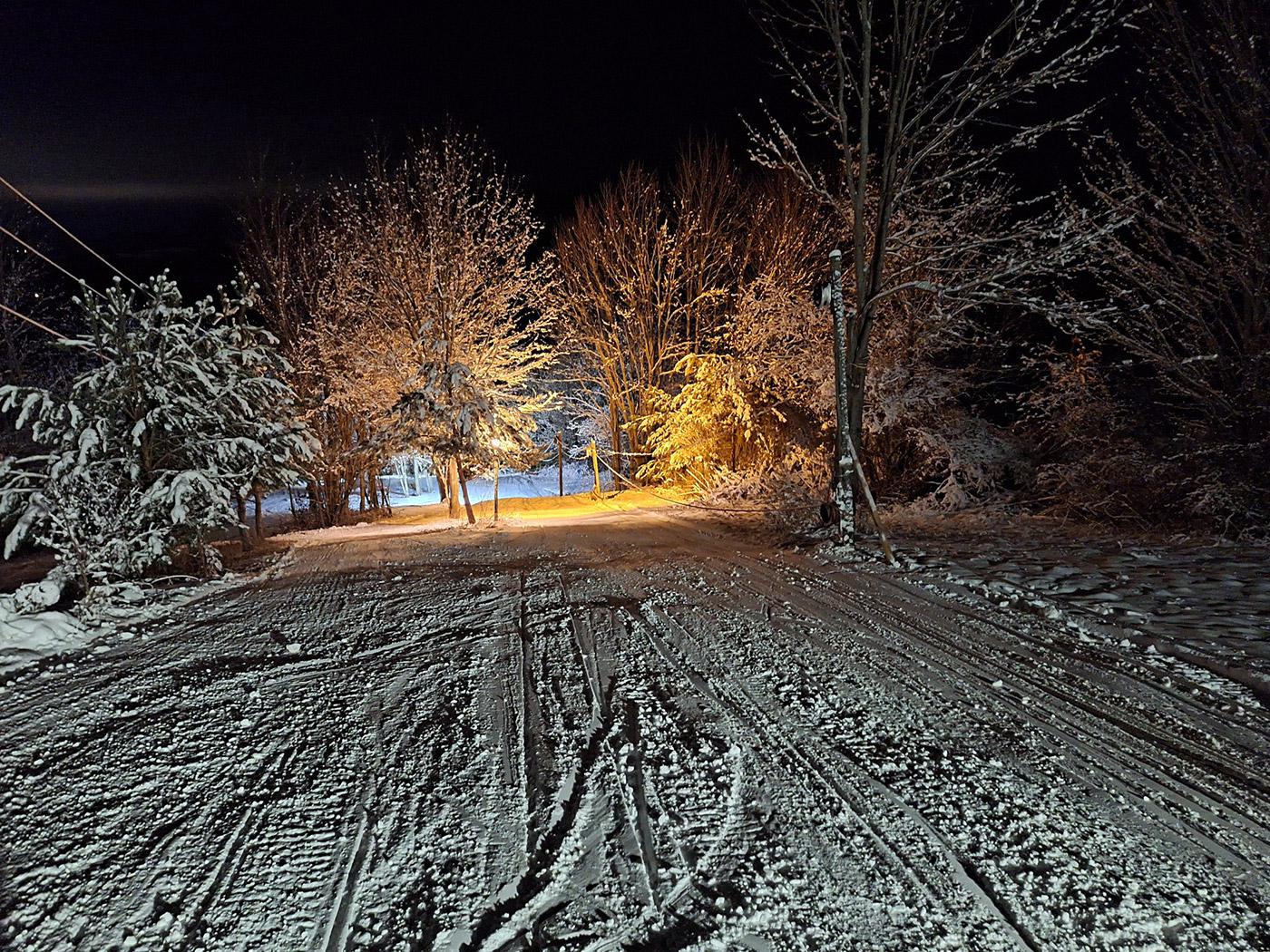
The trail system is where the work is. I mow (some with a push mower), brush hog, and string trim 3 miles of trails several times each summer. I am always adding something new. We went from one trail with night skiing to three this season, for example.
Scott: At a high level, how much does it cost to run your private ski area?
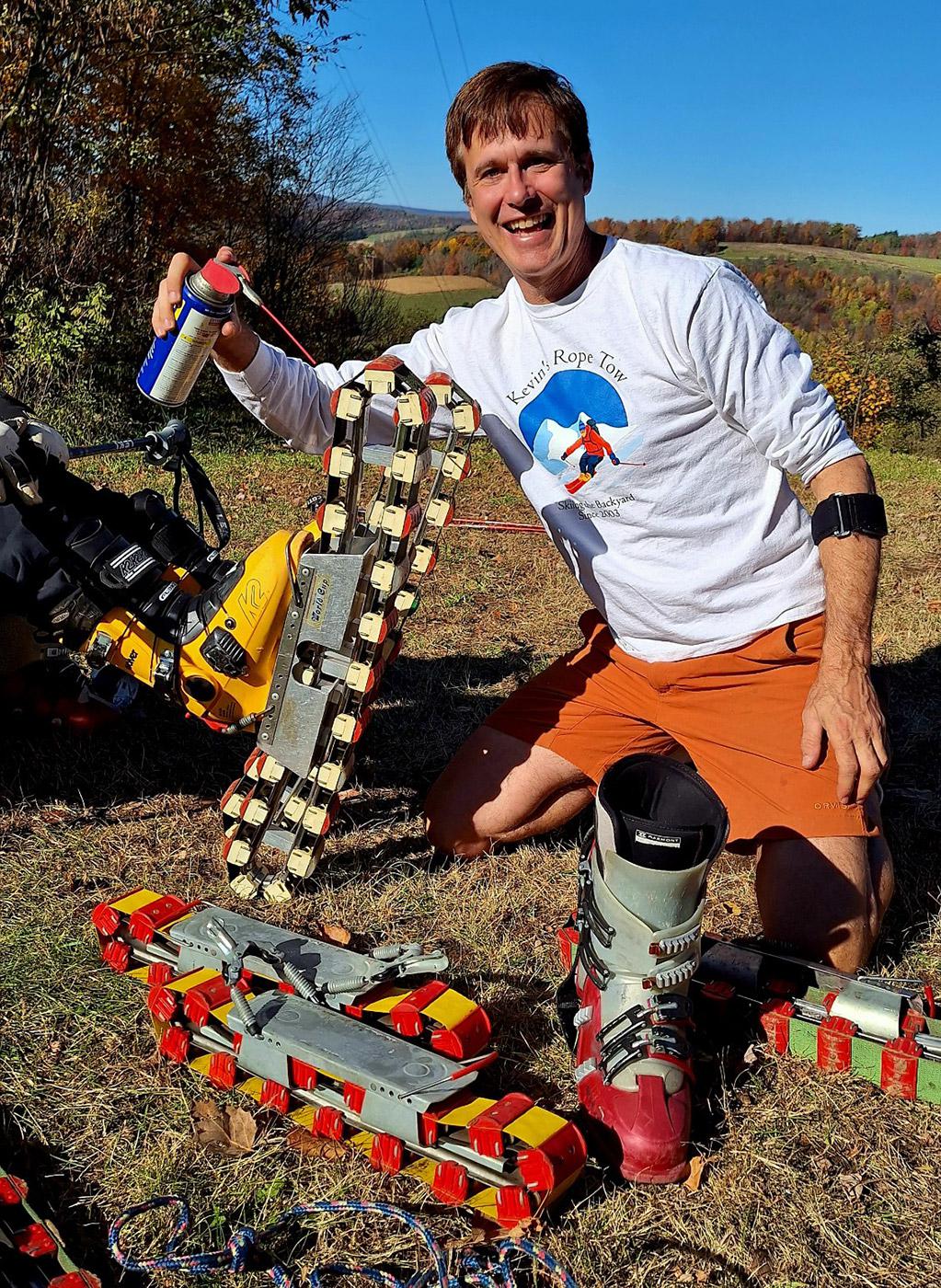
Kevin: I figure I have spent a total of $10k on my ski area in total. 334 days divided by 10k is about $30 a day on average, and dropping each day. Of course that doesn’t include the 15 to 20 acres of land which the ski area covers, my Kabota tractor and my snowmobiles for packing the snow. I have spent more on beer in the last 22 years!
Scott: As a private operation, how do you handle access? Is it limited to family and friends, or does it extend beyond that?
Kevin: I have a small group of ski friends who help with summer maintenance and sometimes ski with me. I originally started my Facebook Page, Kevins Rope Tow, so that I wouldn’t ski alone. For the first 15 seasons I would have maybe one guest a year, and skied alone the rest of the time. I always worried what would happen if I got injured and no one else was there, which motivated the creation of the Facebook page. My page has now grown to 20,000 followers.
Scott: Did you ever consider turning this into something commercial, or was it always intended to remain a personal project?
Kevin: I talked to the state lift inspector 22 years ago and was told as long as it’s only for personal use, I didn’t need to have it inspected. So that is how it is going to stay.
My tow should be able to pass an inspection, as I followed state code in design, but my tow grippers would not be allowed. Without them it would be impossible to ski laps on a tow this long and steep.
Scott: There’s something refreshing about stripping skiing down to its essentials — snow, slope, and a simple lift. What do you think people gain from an experience like this?
Kevin: It’s a sport, not a spa! Skiing used to be so simple. There were rope tows everywhere. Vermont, for example, had 184 documented ski areas, but today only 28 are still in operation!
Everyone today wants snowmaking, trails groomed side to side, fancy lifts that cost 5 million dollars, and huge lodges. It’s fun to get back to the basics. I love visiting places like Cochran’s Ski Area or Northeast Slopes in Vermont, or Mount Greylock Ski Club in Massachusetts, where its purely about the sport.
Scott: Looking back over the years, what has been the most rewarding part of running your own backyard ski area?
Kevin: Living my dream that I had since I first rode a rope tow!
I still sometimes look down my slope in awe, thinking how did I do this? Power days are amazing. Yes, it takes days to track out 14 trails! 20 years ago I was contacted by SKI Magazine and was part of a several page article. I had been a subscriber to SKI Magazine since I was in Junior High, and always read it from front to back. Being featured in it was quite a memorable moment.
Scott: If someone else were considering building a private rope tow today, what advice — or cautions — would you give them?
Kevin: Find the right piece of land. You can build a fun little terrain park on an acre, or find a big hill like I did. Then contact myself or someone who has built a rope tow for their tips and guidance.
I took my note pad to a private tow in New York to learn all I could, including how to splice the rope, how to groom, how to set up safety gates, what engine size to use, how far to set up towers, how much of a bend a rope tow can have, what speed to run it, etc.
TowPro from New Hampshire, sells complete, ready-to-go set ups for less than a new snowmobile. That’s probably the easiest option for anyone.
M. Scott Smith is the founder and Editor of DCSki. Scott loves outdoor activities such as camping, hiking, kayaking, skiing, and mountain biking. He is an avid photographer and writer.


Join the conversation by logging in.
Don't have an account? Create one here.

 SKI Magazine.” class=”rounded img-fluid”>